What Makes a Simulation Work: The 4 Essentials of Engagement and Learning
Discover the core design principles that make learning simulations engaging, inclusive, and effective for global teams, classrooms, or leadership development.
December 1, 2025
Michael Bean
Key Takeaways
The most effective simulations succeed because of thoughtful design anchored in Forio’s F.A.C.E. framework: Fun, Accessible, Clear, Educational.
2 case studies show how F.A.C.E. principles turn simulations into engaged learning, healthy competition, and sustainable outcomes.
Ultimately, a simulation’s success is defined by user enthusiasm, organic adoption, and lessons that stick long after the experience ends.
Simulations have evolved; the fundamentals haven’t.
Whether it’s leadership development, academic instruction, or enterprise training, the difference between a simulation that sticks and one that falls flat isn’t technology – it’s design. Drawing on decades of experience building and running award-winning simulations for global organizations, Forio developed a simple framework to capture what makes learning experiences truly effective, F.A.C.E Value.
- Fun
- Accessible
- Clear
- Education
The Four Key Attributes of Successful Simulations
When a simulation is FUN, learners are immersed.
They’re more engaged when they feel competitive, curious, and motivated to explore outcomes. A fun simulation sparks emotion and experimentation, letting players test ideas, take risks, and stay engaged long enough for real learning to happen.
When a simulation is ACCESSIBLE, it’s easy for anyone to join and participate.
Without technical barriers or exclusive tools, accessibility also means inclusivity:
- Clear visuals to accommodate color blindness
- Readable contrast
- Support for screen readers
- Intuitive UI and UX for all learners
As in the real world, a great simulation meets people where they are, not the other way around. This approach aligns with global standards like the W3C Web Accessibility Initiative, which defines accessibility as designing for all people, regardless of ability, context, or device.
When a simulation is CLEAR, every participant understands what they’re trying to accomplish.
For both individuals and the collective, the objectives, rules, and story context should be transparent from the start. The simulation should provide immediate feedback so players always know the impact of their decisions. In simulations, clarity means:
- Defined roles and goals
- A clear, overarching mission or narrative (why the simulation exists)
- Visibility into leadership or decision-making structure
- Feedback that connects choices to outcomes
When a simulation is EDUCATIONAL, every interaction connects to a clear learning objective.
The behaviors, outputs, and results reinforce skills or insights learners can apply immediately – in the classroom or the board room – after the simulation ends.
It’s also useful to consider an attribute that isn't part of the acronym, realism.
When REALISM is part of the simulation design, it can enhance the experience.
But only when it serves engagement (fun) and clarity. Too much detail can impede learning, while the right amount of authenticity helps players connect decisions to real-world outcomes. The goal isn’t perfect accuracy; it's a believable context that keeps learners immersed.
From Principles to Practice: What Successful Simulations Look Like
The F.A.C.E principles aren’t theoretical. They play out every day in Forio simulations used by Fortune 500 companies and elite universities around the world to help millions of learners build skills through experiential practice. To show how these principles work in different settings, here are two Forio simulation case studies that demonstrate what success looks like in practice.
Case Study 1: Competitive Strategy Wargame
Context and Challenge
In the early 2000s, a global manufacturer of capital equipment was losing market share to new international competitors. Emerging markets offered growth opportunities, but only if the company could rethink its long-standing approach. Customers in these regions needed simpler, more affordable products than the company traditionally made. Leadership realized the organization had to fundamentally change how it operated to compete and win globally.
Simulation Design
To help leadership internalize this new strategy, the CEO organized a three-day offsite for 100 senior managers. Alongside presentations and planning sessions, participants ran a competitive strategy simulation – a “corporate wargame,” if you will.
Ten teams represented rival companies in a shared global market. Every gain in market share came at another team’s expense, mirroring real-world competition.
Constraints and Approach
The CEO wanted the event to be both strategic and energizing, packed into three days that also allowed time for networking and rest. To accommodate everything, simulation rounds were scheduled before breakfast, during lunch, and after dinner.
The concern: managers might disengage during what were normally downtime hours.
Engagement and Dynamics
Instead, the opposite occurred. Teams became fiercely competitive within the designated hours. Evenings that usually ended at the hotel bar turned into late-night strategy sessions. Managers debated tactics, formed alliances, and even merged teams mid-game to gain advantage.
Daily performance updates and “market news” were shared through printed briefings (remember, this was in the early 2000s!), fueling even more enthusiasm.
Results and Impact
The simulation delivered a vivid, memorable learning experience. Managers grasped the logic behind the company’s new vision and gained intuition for how to execute and implement it. Engagement and enthusiasm was palpable; one participant wore his “gold medal” from the winning team to the final breakfast.
F.A.C.E. in Action
- Fun: Competition and recognition (medals, rankings, market news) made the experience exciting and memorable.
- Accessible: Designed for an in-person event, the simulation was easy to follow and engage with. No complex tech required, just clear structure and team play that included everyone.
- Clear: Roles, goals, and feedback were obvious; teams always knew how their decisions affected results.
- Educational: Managers walked away with a deeper understanding of strategic trade-offs and market dynamics that they could easily implement with their teams at home.
- (Realism): The simulated market mirrored the company’s real environment closely enough to feel authentic without bogging down the play.
The exercise proved to be a cost-effective way to communicate complex strategic shifts quickly – and was later reused by managers to train their own teams.
Case Study 2: The Babson College Mindset Game
Context and Challenge
Babson College wanted learners to experience the difference between a managerial mindset and an entrepreneurial mindset. Many students and professionals default to structured, instruction-driven thinking, even in situations that required creativity, experimentation, and action under uncertainty. Faculty needed a way to surface those instincts and challenge them directly.
Simulation Design
This team-based simulation was built around two contrasting challenges. In the first round, teams race to complete a puzzle using a reference image. The task is structured and familiar, rewarding efficiency and coordination.
In the second round, teams receive a single prompt word and access to a collaborative drawing tool with no instruction provided. They must experiment, manage limited resources, create a shared story, and present it to the group. Outcomes are determined by peer voting.
Constraints and Approach
The simulation was designed to run in a short instructional window and work equally well in classrooms and virtual sessions. Instructions were intentionally sparse to encourage learning by doing, particularly during the entrepreneurial challenge.
Engagement and Dynamics
Teams move confidently through the puzzle, quickly adopting managerial strategies. That confidence often fades in the second round, where ambiguity forces experimentation and collaboration. Faculty report high energy, lively discussion, and strong engagement across the audiences.
Results and Impact
Participants gained firsthand insight into their own default ways of working. The experience highlights how structure and ambiguity shape decision-making, reinforces the value of both mindsets, and sets the stage for deeper discussion about innovation and collaboration.
F.A.C.E. in Action
- Fun: Competition, time pressure, and creativity spark laughter, energy, and genuine investment from players.
- Accessible: Minimal technology required; intuitive tools; no artistic ability needed.
- Clear: Each round has simple objectives, and the contrast between them becomes the learning.
- Educational: Participants learn how managerial and entrepreneurial thinking differ, why both matter, and when each one helps or hinders progress.
- (Realism): While the tasks are playful, they mirror real behaviors in teams: some people wait for instructions; others prototype; others coordinate. These dynamics map directly to real organizational challenges.
Measuring Success: The F.A.C.E. Value for Simulations
These two simulations – very different in audience, format, and purpose – succeeded because they used just enough realism to make decisions feel meaningful while staying focused on F.A.C.E. principles. Each simulation example proved that when those four attributes work together, learning comes quite naturally.
You can think of a simulation’s effectiveness as its F.A.C.E. Value, how well it performs across the four key attributes. If one falls short, the overall experience does, too.
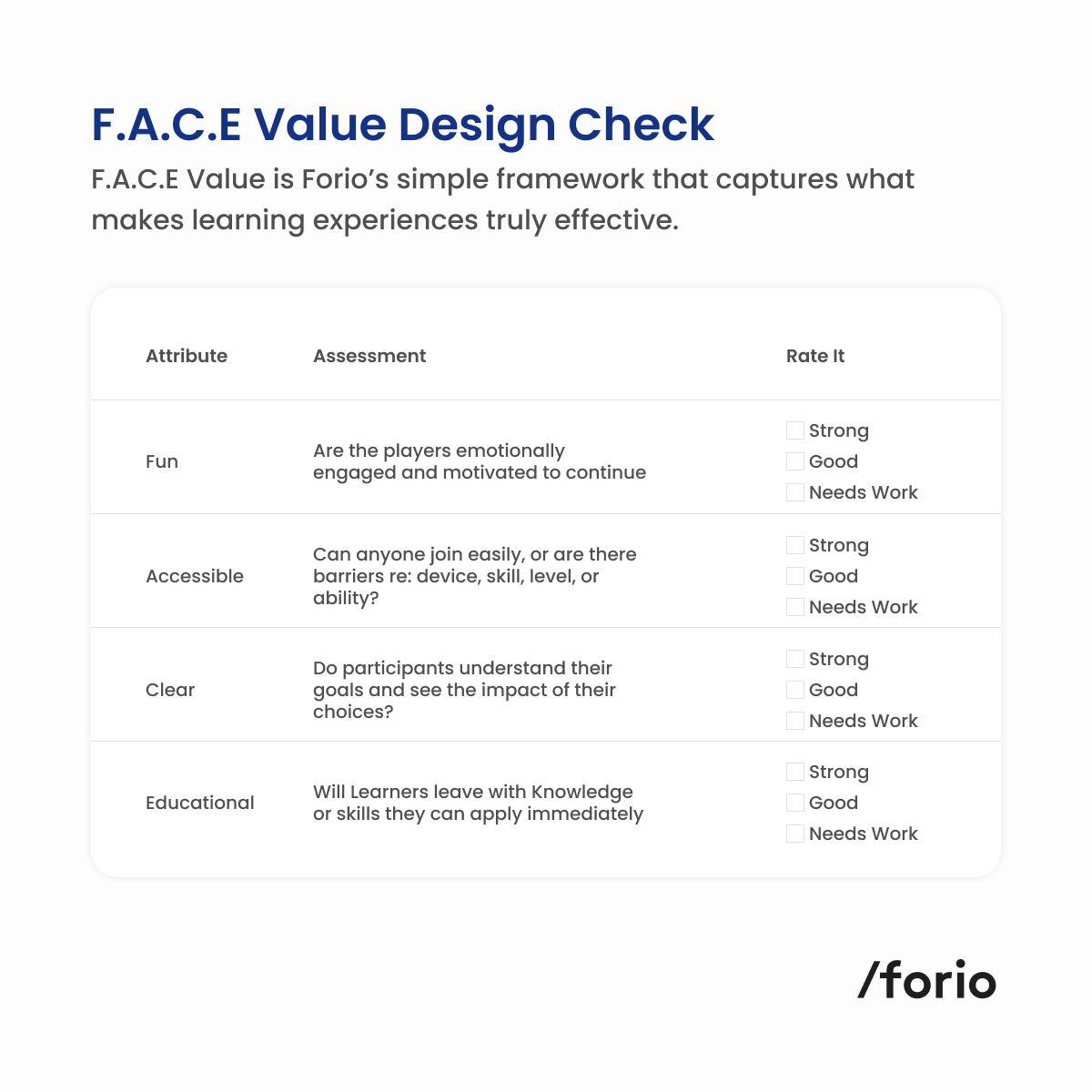
Use this F.A.C.E. Value grid as a quick design check-in for viability. Rate each attribute on a simple scale – from “Needs Work” to “Strong” – to see where your simulation delivers and where it needs refinement to inform a final iteration.
The more attributes that land in the “Strong” column, the higher your simulation’s overall F.A.C.E. Value, and the more likely it is to make a lasting impact.
Designing Simulations That Stick
Ultimately, simulation success is determined by your users; so there’s also a simple top-down approach to measuring success:
- Did people enthusiastically use the simulation without being required to?
- Did they tell their friends or colleagues about it because they think they’d also enjoy it and benefit from it.
- Did the simulation lead to real changes in how participants think, decide, or perform afterward?
Successful simulations don’t require a lot of advocacy and persuasion to motivate potential users because people are internally motivated to play them. The use of the simulation spreads via word-of-mouth throughout your organization. Colleagues compete with each other and proudly discuss their successes with others. Eventually, a successful simulation can become ingrained as part of a shared corporate culture and history.
In fact, 60% of MBAs at Harvard – and other schools like USC, Cambridge, Cornell, Georgetown, and Oxford's Saïd Business School – will complete the Mt. Everest simulation before they graduate. Harvard Business School and Forio developed this test of psychological safety, swift decision making, leadership, and team building that’s become a highly-anticipated rite of passage for these students.
When a simulation is designed with success in mind from the start, then the key lessons stick. The simulation will have had a deep impact on affecting the future success of the organization, long after the exercise ends.