Corporate Training Simulations
Forio corporate training simulations build the strategic thinking, management capability, and decision-making skills that modern organizations demand.
Forio corporate training simulations build the strategic thinking, management capability, and decision-making skills that modern organizations demand.

About Corporate Training Simulations
Corporate training simulations are experiential learning tools that place participants inside realistic, high-stakes business scenarios where decisions and their consequences become the lesson. Rather than reading about strategy in a classroom or reviewing case studies in a lecture hall, learners engage directly with each other and the content: running companies, navigating change initiatives, managing supply chains, and competing in markets where outcomes are immediate and visible (but without the risk), making them ideal for leadership development and corporate learning programs.
These simulations are designed to surface the complexity of real organizational challenges, including:
- Allocating resources under uncertainty
- Coordinating across functions with competing priorities
- Responding to market shifts and operational disruptions
- Making strategic trade-offs with incomplete information
They’re most effective when they reflect the environment learners actually operate in, where decisions have second- and third-order effects, teams must align quickly, and there is rarely a single correct answer.
Corporate training simulations in Forio's simulation catalog span topic areas such as:
- Business management strategy
- Change management
- Supply chain
- Negotiation
- Project management
- Leadership development
Built in partnership with renowned institutions, including Harvard Business Impact, MIT Sloan, Wharton, and Michigan Ross, Forio simulations have reached more than 10 million learners across corporate L&D programs, executive education cohorts, and MBA curricula for more than two decades.
Featured Corporate Training Simulation
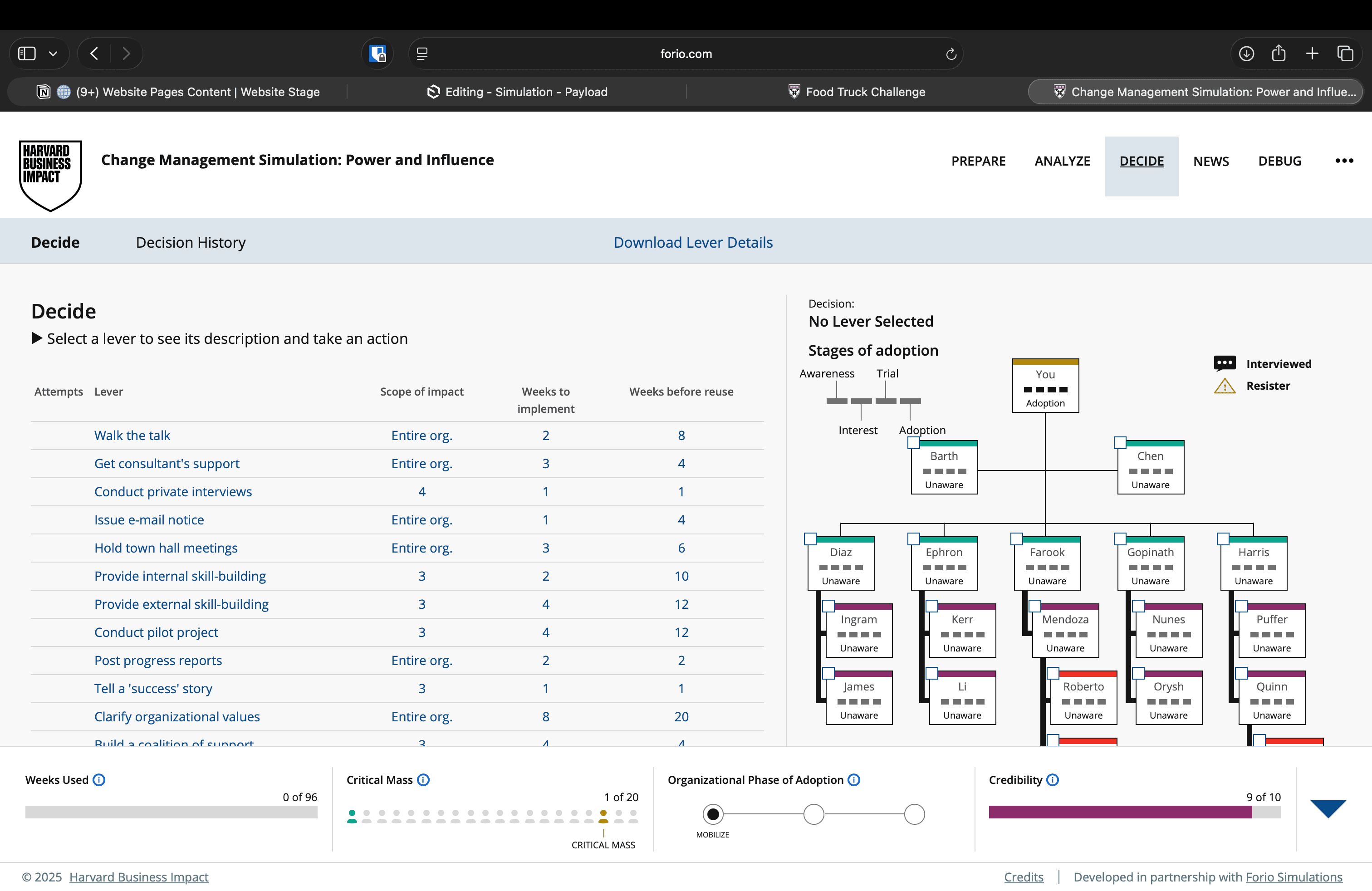
Developed by Harvard Business Impact, the Change Management Simulation: Power and Influence simulation places participants in the role of a change agent navigating a complex organizational transformation. The simulation requires learners to build coalitions, manage resistance, and drive adoption across a company where competing agendas and diverse, established stakeholders exist.
Participants choose from a range of influence strategies, each with distinct trade-offs, and must adapt as the organization responds. The Change Management simulation experience highlights the dynamics that most often derail change efforts in practice:
- Insufficient buy-in
- Poor timing
- Underestimating informal power structures
- Unclear ownership
- Communication breakdowns or inconsistencies
- Competing priorities
It's a practical, high-engagement tool for organizations developing change-ready leaders or preparing teams for restructuring, transformation, or cultural shifts.
Corporate Training Simulations
Forio's corporate training simulation catalog covers the full range of management and organizational development topics most requested by L&D programs and executive education teams, including:
- Strategy and corporate decision making
- Change management
- Leadership and teamwork
- Negotiation and conflict resolution
- Supply chain and capacity planning
- Project management
- HR management
- Organizational behavior
These single- and multiplayer simulations are designed to scale from individual learners to enterprise-wide programs while maintaining a consistent, high-quality experience across in-person, remote, and hybrid delivery.
Change Management
Power and Influence

A Harvard Business simulation, where the learners lead organizational transformation at a sunglasses manufacturing company as a change leader—build credibility, manage resistance, and use influence strategically to drive meaningful, lasting change.
Check It Out
Leadership and Teamwork
Everest

The best-selling Harvard Business Impact simulation where learners climb Mount Everest, balancing personal goals, health, and team success while managing limited information, time pressure, and leadership decisions that test collaboration and communication.
Check It Out
Leadership and Teamwork
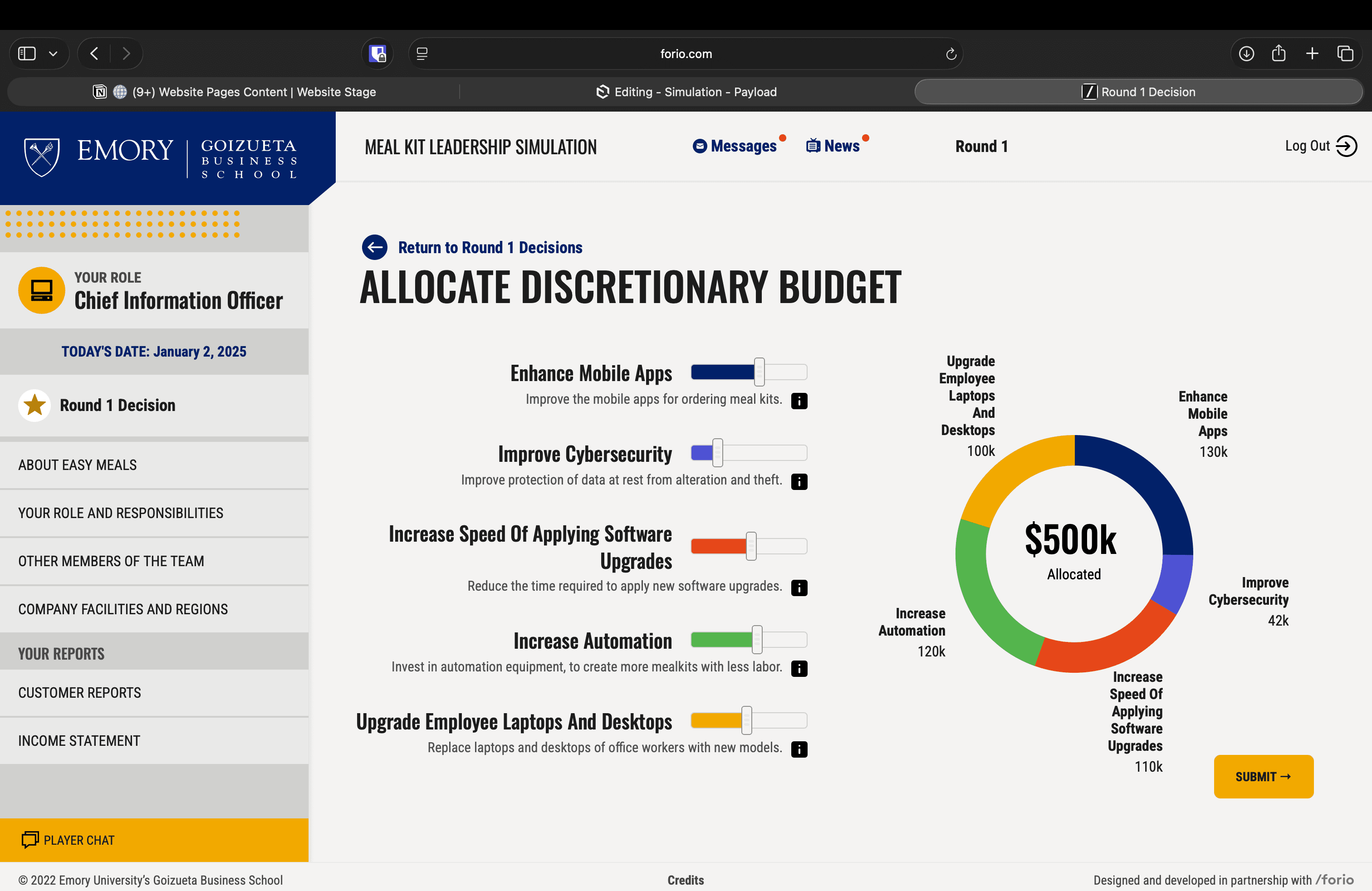
Easy Meals

In this leadership and communication simulation, learners respond to crises by making individual and team decisions. While facing multiple challenges, learners practice effective and consistent communication, evaluate trade-offs, and seek group consensus.
Check It Out
The Forio team is highly responsive, solutions-oriented, and eager to help. They've enabled wonderful virtual learning environments for our globally distributed employees and we look forward to our continued partnership!
Cathy Huang, Delivery Hero
Benefit of Corporate Training Simulations
Forio's corporate training simulations have earned their place in L&D programs and executive education curricula by delivering something lectures, case studies, and online tutorials reliably cannot: experiential learning that sticks because the material becomes tangible rather than abstract.
Strategic thinking develops through practice, not instruction. Participants make decisions inside a responsive environment where strategy, operations, and unpredictable human behavior intersect. The feedback (and sometimes consequences) is immediate and tied directly to each learner’s own choices and actions.
Simulations accelerate management judgment. Learners encounter the kinds of situations that typically take years of on-the-job experience to encounter and sufficiently navigate. Corporate training simulations compress that exposure into hours, building confidence and familiarity with situations like resource constraints, conflicting stakeholder needs, and shifting priorities.
Teams surface alignment problems before they become operational. When a cross-functional group participates in a corporate training simulation together, the places where communication breaks down, assumptions influence decisions, and priorities conflict become visible in a low-risk environment.
Retention is higher when learners participate rather than observe. The decisions participants make, the mistakes they make, and the outcomes they experience tend to stick in ways that passive formats, like didactic lecture hall presentations, cannot produce.
Corporate training simulations scale without compromising quality or consistency. Whether a simulation runs for an in-person team of 12 or a hybrid cohort of 500, every learner has the same experience. Forio's platform supports synchronized, real-time play across distributed locations.
How to Effectively Implement Corporate Training Simulations
Corporate training simulations deliver the most value when the learning objective is defined before the simulation is selected, not after. It's easy to choose a simulation because it sounds compelling or because colleagues have recommended it. But the more important question is whether it maps to the specific behaviors, skills, or outcomes the program is designed to produce. The simulation should serve the objective, not the other way around.
The most common implementation mistake is treating a simulation as the program itself. It works best as the centerpiece of a broader learning program, where concepts are introduced in the classroom or coursework first, and the simulation is where participants step out of the material and into the simulated reality. Preparation, facilitation, and structured debrief are what convert that experience into insight that transfers back to the job.
In corporate settings, simulations work best when tied to a specific organizational moment. The more specific the objective, the more the debrief will reveal. For instance:
- A leadership cohort preparing for expanded responsibility
- A team navigating a cultural change initiative
- A cross-functional group seeking alignment around a strategy and execution
In executive education and MBA programs, corporate training simulations bridge the gap between coursework and application. They give participants a place to stress-test frameworks under realistic conditions with real time pressure, incomplete information, and other people making decisions that affect their outcomes.
Forio's catalog includes both Ready-Made simulations and custom simulation builds designed for an organization's specific industry, challenge, or internal scenario. Either way, the implementation variables that determine whether a simulation lands are the same: a clear objective, a facilitator who knows the material, and a debrief with enough structure to connect what happened in the simulation to what happens at work.
Train with simulations created by world-renowned faculty and institutions