How a Wildfire Mitigation Simulation is Teaching Public Policy and Group Communication
Forio’s Custom Simulation platform enabled CU Boulder professors to develop a real-world learning scenario for communications students.
November 5, 2025
Professor Matt Koschmann
Key Takeaways
Professor Matt Koschmann developed a public policy simulation focused on wildfire mitigation to teach group communication, negotiation, and decision making.
Drawing from academic research and real-world observation, CU used Forio’s Custom Simulation platform to develop a dynamic experiential learning tool now used across multiple universities.
Professors enjoy using the simulation in class because it prompts so many varied class discussions and teachable moments.
Professor Matt Koschmann, an Associate Professor of Communication at the University of Colorado Boulder, developed the Wildfire Mitigation Simulation with Forio to provide students with a realistic way to practice group communication, negotiation, and decision making. Using Forio’s Custom simulation platform, he transformed public-policy challenges into an experiential learning tool now adopted across multiple universities, demonstrating how simulation-based training bridges the gap between communication theory and real-world collaboration.
The Purpose: Why Traditional Communication Classes Fall Short Without Practical Experience
The idea for this Wildfire Mitigation Group Communication Simulation came from my experiences teaching group and team communication classes at the university level. One of the biggest challenges we face teaching communication classes is the tension between authenticity and control. That is, we want students to have a realistic experience, but we also want this to happen within the confines of a structured learning environment.
This is tricky to achieve because communication as a topic is different from many other subjects. For example, when you’re working on an equation in a math class you’re literally doing math. But that’s not the case with communication. You can sit in class and discuss conflict management or even write a case study about intercultural differences, but in each of these situations you’re not really doing communication, you’re just talking about it.
We all know that merely talking about a skill is much different than actually practicing or doing it.
Conversely, simulations enable us to put students in real-world scenarios where they can have authentic experiences. While I’ve incorporated service-learning assignments into several of my previous classes with positive results, they can also be incredibly time consuming, difficult to manage, and unpredictable. Just ask my students whose primary contact at a local company got fired half-way through their project!
I’ve always aimed to design balanced assignments that are both realistic and manageable, giving students opportunities to apply communication theory to real-world situations. While exploring Forio’s online simulations – including popular titles like Everest and Judgment in a Crisis – I found strong examples of experiential learning for teamwork and decision making. However, none fully captured the civic and interpersonal dynamics central to my group communication courses.
That gap inspired me to create a custom simulation focused on collaboration, stakeholder communication, and community decision making. With support from a University of Colorado Boulder technology grant, I partnered with Forio to develop a tailored simulation for group communication and adaptable for others teaching similar courses.
How the Wildfire Simulation Project Began At CU Boulder
We wanted a non-business scenario that didn’t focus on finance or market success that could bring multiple stakeholders together. They’d have different or competing interests, but needed to work together to reach consensus on an issue that was equally important to everyone. So many other great business simulations were already available; we wanted to develop something unique that emphasized a community-oriented process relevant to public administration and civic engagement.
Why Wildfire Mitigation Is an Ideal Case Study for Real-World Education Simulations
Wildfire is a critical issue here in the West, an ever-growing threat that made this a timely and compelling story for a public policy and communications simulation. In fact, in the past two decades, the average annual acreage burned in the US due to wildfires has more than doubled, from three million to more than seven million acres.
Jared Kopczynski, a graduate student who previously worked as a teaching assistant for my group communication class, worked with me to create the storyline for our simulation, aiming to model how diverse stakeholders navigate complex community planning decisions.
We drew upon the expertise and resources readily available to us, including our colleague in communications, Professor Jody Jahn, a former wildland firefighter herself, and my own familiarity through my father’s career in the U.S. Forest Service. We interviewed local wildfire experts and observed real community mitigation meetings in a nearby mountain town to ensure the scenario reflected the dynamics of authentic public decision making.
The Simulation Prototype: Building the Scenario and Stakeholder Roles
After several months of background research, the storyline for our custom simulation took shape around characters and situations that were most relevant to community wildfire mitigation planning.
The simulation modeled a citizens taskforce that would deliberate over a five-month period involving five meetings to develop a wildfire mitigation plan to protect their community.
That taskforce was made up of five “meta-characters” that represented most of the interests and motivations we had learned about, having the greatest impact on the planning outcomes:
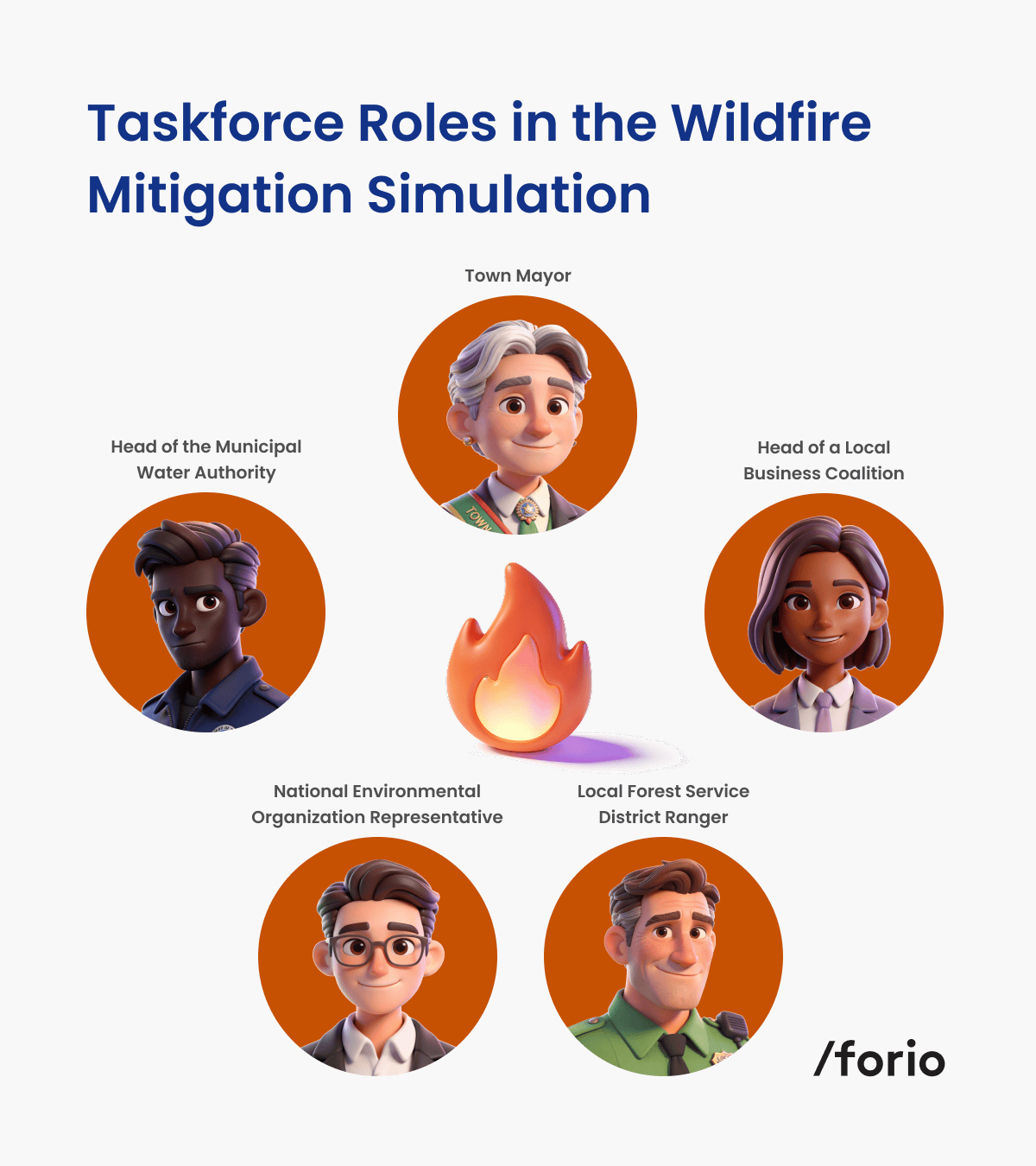
- Local Forest Service District Ranger
- National Environmental Organization Representative
- Head of a Local Business Coalition
- Town Mayor
- Head of the Municipal Water Authority
We also developed several subplots, dilemmas, and unexpected events to be woven into the storyline to make it as realistic an experience as possible. These show up contextually in email messages and social media posts that the characters receive between taskforce meetings.
With a working prototype, we ran a series of focus groups with undergraduate students to gain feedback about our simulation and identify any technical or experiential issues that had to be worked out before a full launch.
Going Live: Launching the Simulation in Real University Communication Classes
The simulation officially launched in CU Boulder’s large group communication class during the 2016-2017 school year. It was immediately seen as a huge success with the students. It wasn’t exclusive to the CU Boulder campus for long! It was quickly picked up at five other universities, including USC, Utah State, University of Miami, Kansas State, NYU, and University of Michigan, with more inquiries from interested professors coming in every month.
Since this simulation’s launch in 2016, it remains one of the most popular in the Forio simulation catalog. We estimate that 1 million students have completed the wildfire mitigation simulation, improving practical communications education at the college level and preparing these students for a more informed start to their public policy and civic leadership careers.
The feedback has been consistently positive, with students saying they like:
- How the simulation develops over multiple rounds and several in-class meetings, giving students time to immerse in the storyline and identify with their characters.
- That the simulation is fun, engaging, and interactive, as well as realistic and applicable.
- Doing group communication and decision making in ways that seem relevant for their lives and professional pursuits.
- Learning lessons beyond the immediate topic of fire mitigation, including:
- Conflict management
- Coordination
- Information sharing
- Compromise
- Persuasion and advocacy
- Scenario planning
- Balancing competing interests
- Understanding different perspectives
I’ve had the chance to observe dozens of student groups play our simulation and it’s great to see their genuine enthusiasm and enjoyment. In fact, many professors have told me how much they enjoy using the simulation in class because it provides so many scenarios for class discussions and teachable moments.
We’ve been thrilled by how the simulation developed and excited to see how people use it in the future.