
Fashion Forward
Circular Economy Simulation
Simulation Overview
In this simulation, learners assume leadership of a fast‐fashion company and manage its Design, Manufacturing and Retail operations over a five‐year horizon. Their mission: pivot the business from a traditional “take-make-waste” model toward a circular economy model—without sacrificing profitability.
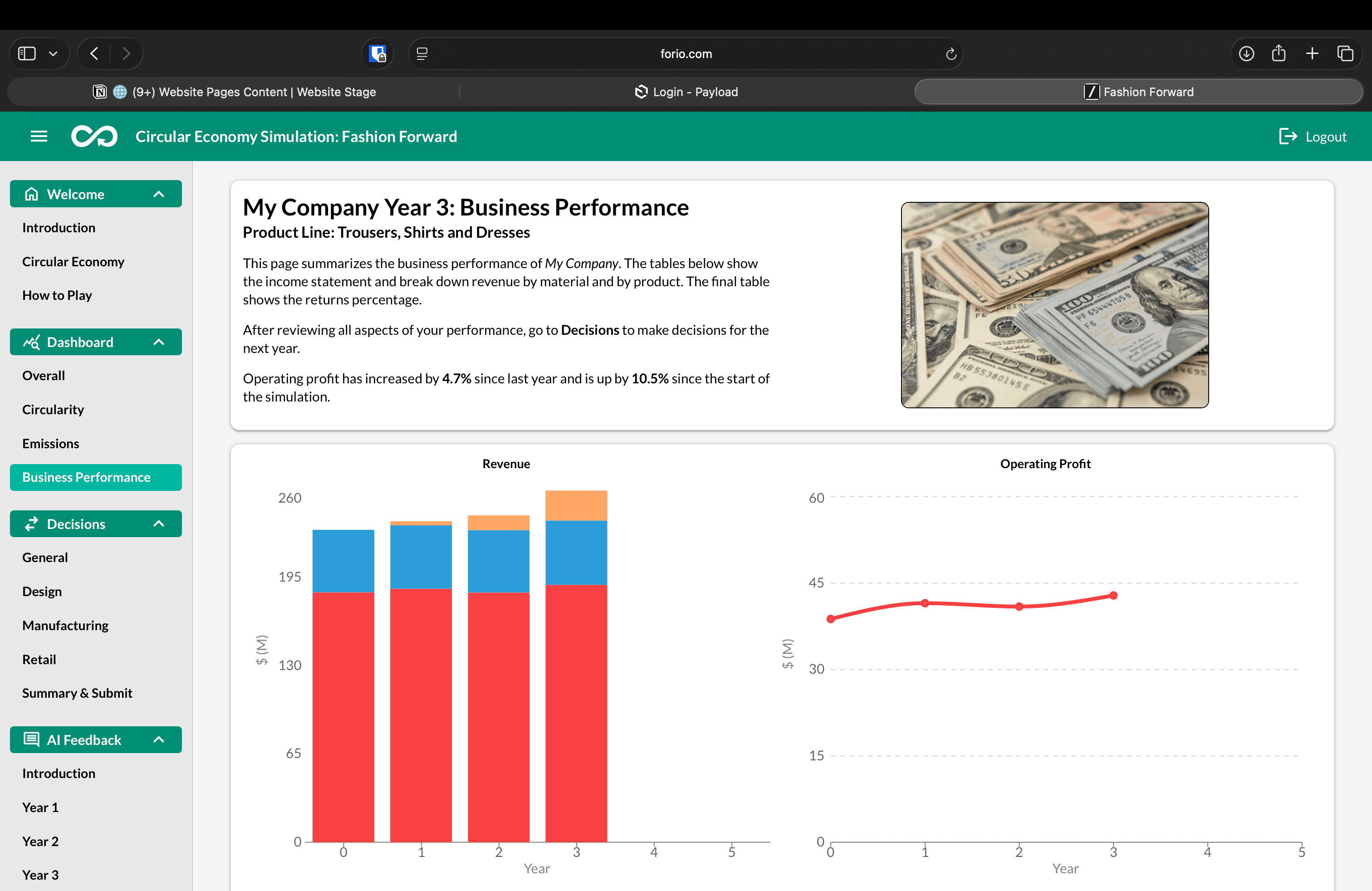
Along the way they will choose a product line, select from a range of circular initiatives across the value chain and invest in staff training and R&D. Each simulated year delivers dashboard feedback on key performance indicators such as circularity, waste reduction, greenhouse gas emissions and profitability.
The simulation enables repeat plays to refine strategy, explore alternate product lines or test different business model levers.
Players

Multiplayer
Single Player
Languages

English
Simulation Time

Total Time: 1.50-1.75 hours
Intro 15 minutes, Gameplay 1 hour, Debrief 20-30 minutes
Accessibility

WCAG 2.1 Compliance
Price

$168 per person
Simulation Categories

The Story
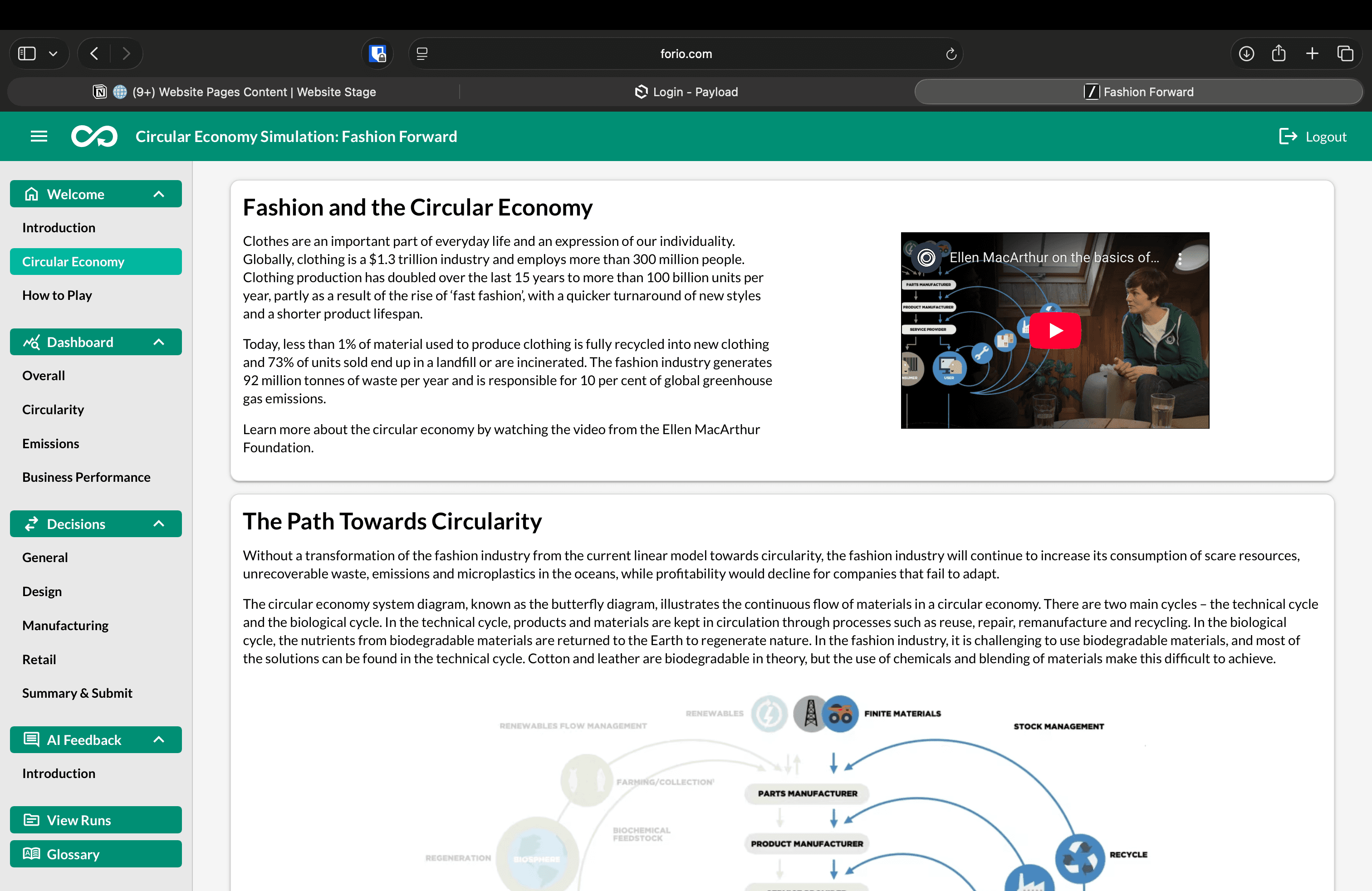
You manage a global fast-fashion company operating in a growth-driven apparel market that produces over 100 billion units of clothing annually, with less than 1% of materials fully recycled and 73% of units ending up in landfills or incinerators.
The company has built its success on rapid design-to-retail cycles, low cost production and high volume sales—but mounting regulatory pressure, rising consumer demand for sustainable credentials, and increasing waste and emissions mean that remaining on the linear path is no longer viable.
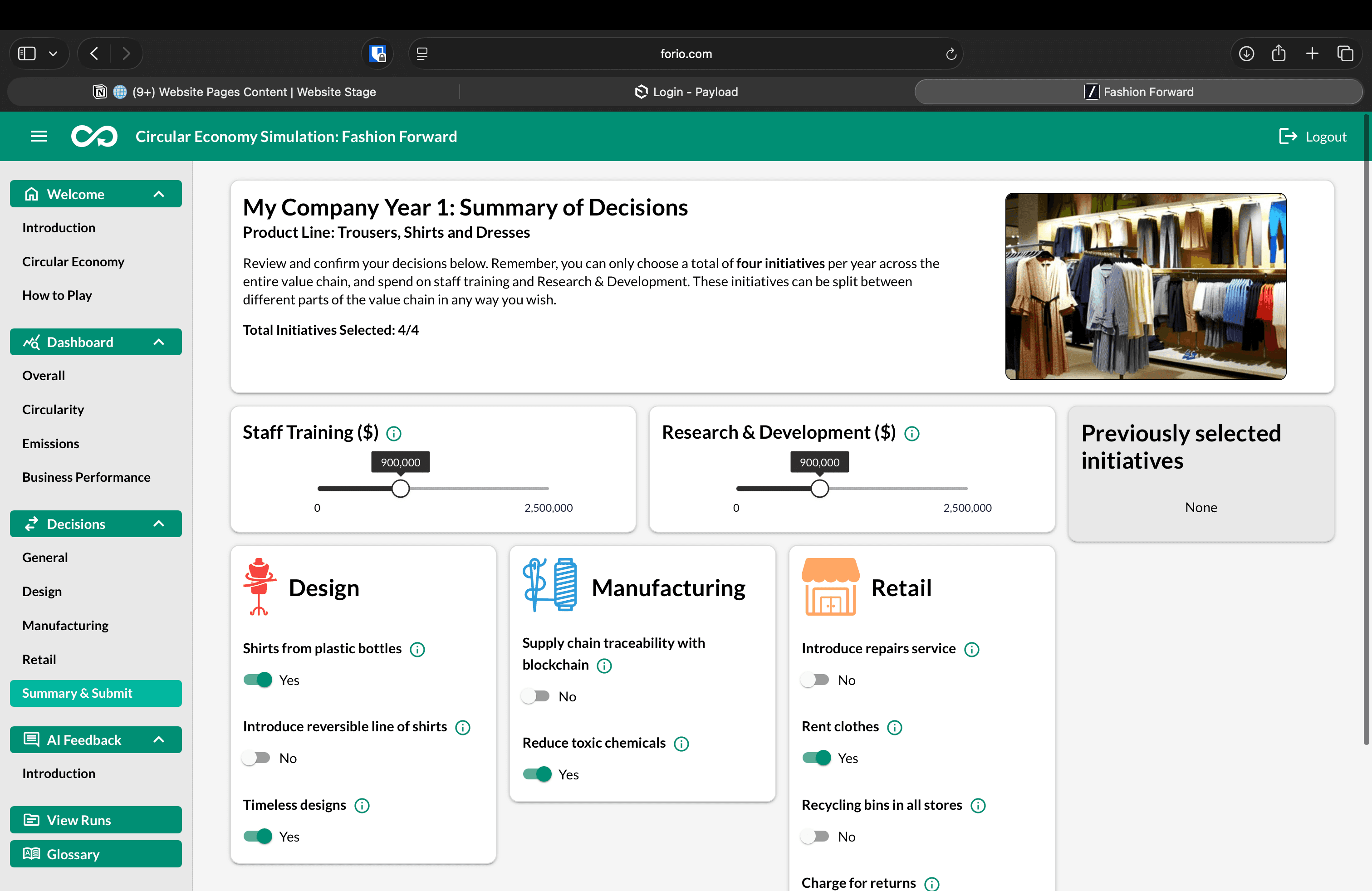
Over five simulated years you must choose a product line and then each year select initiatives that move the company toward circularity: redesigning products for extended life, optimizing manufacturing processes, launching take-back/repair/ rental models, reducing greenhouse gases, and managing cost and investment trade-offs. As you do so you monitor how your choices affect profitability, waste, emissions, and circular metrics.
You’ll learn that while circularity offers major sustainability benefits, the transition is far from simple: business models must evolve, operations must adapt, and the tension between growth and resource-efficiency must be managed. The skills and insights learned extend far beyond fashion: any industry undergoing transition from linear to circular models can benefit.
Core Competencies
Strategic Decision Making
Environmental Awareness
Critical Thinking and Problem Solving
Learning Objectives
Resources to Power Your Simulation
This simulation comes with a Facilitation Guide along with 1:1 facilitator training and free trial accounts.
Available with this simulation
Facilitation Guide

Debrief Slides
Intro Slides
Free Trial & Demo
Check Out Similar Forio Sims
Public Policy
Healthcare Management Simulation

Bring strategic decision-making to life with the Hospital Operations Simulation, a powerful experiential learning tool for healthcare professionals.
Check It Out
Strategy
Coffee Shop Inc.
Learners manage the strategy and operations of a coffee shop, progressing from a single store to a global chain, making decisions on strategy, operations, marketing, and HR.
Check It Out
Sustainability
Net Positive Hospitality
Lead a hotel through seven years of strategic decisions to advance along the Pathway to Net Positive Hospitality. Balance impact across People, Planet, Place, and Prosperity while navigating crises, stakeholder expectations, and evolving sustainability initiatives.
Check It Out